Blackjack Standard Strategy: Complete Guide for Beginners and Online Players
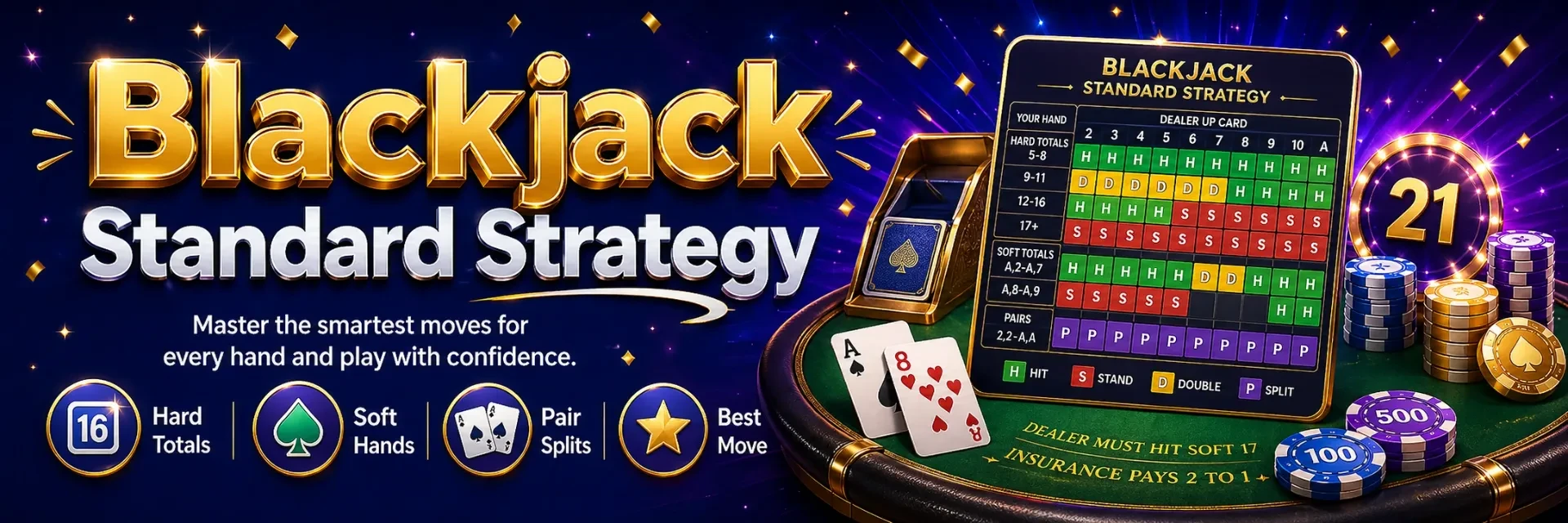
Blackjack standard strategy is the foundation of smart blackjack play. Instead of guessing when to hit, stand, double down, or split, standard strategy shows the mathematically best move for each hand based on your cards and the dealer’s upcard. This guide explains how blackjack basic or standard strategy works, why it matters, how to use it with hard totals, soft totals, and pairs, and how table rules can change the best decisions.
What Is Blackjack Standard Strategy?
Blackjack standard strategy, often called blackjack basic strategy, is a set of mathematically correct decisions that tells you the best move in every common blackjack situation. It is based on probability, not emotion, superstition, or guesswork. The goal is to reduce the house edge as much as possible by playing each hand in the most efficient way.
In practical terms, standard strategy tells you when to:
- Hit
- Stand
- Double down
- Split pairs
- Surrender, if the table allows it
Many beginners think blackjack is only about getting close to 21, but that is only part of the game. Real blackjack strategy is about comparing your hand to the dealer’s upcard and making the best available decision. If you want a more general overview first, you can also read our guide on rules in blackjack, which explains the foundations of how the game works.
Standard strategy does not guarantee you will win every hand. It simply helps you make the best long-term decision in each situation.
Why Blackjack Standard Strategy Matters
Blackjack is different from many other casino games because your decisions affect the long-term outcome. In games like bingo or keno, there is very little strategic decision-making once the round begins. In blackjack, however, the way you play a hand directly influences your expected return over time.
If you play without strategy, the casino edge becomes larger because you will often make avoidable mistakes. If you use correct standard strategy, you reduce those mistakes and move much closer to the game’s best possible theoretical return.
That is why standard strategy is so important. It is not about finding a “secret system.” It is about avoiding unnecessary errors and making the right move consistently.
The Goal of Standard Strategy
The goal of standard strategy is simple: make the move with the highest expected value. Sometimes that means standing on a strong total. Sometimes it means hitting a weak total. Sometimes it means doubling down in a favorable spot or splitting a pair.
The best decision depends on two main things:
- Your current hand total or hand type
- The dealer’s visible upcard
For example, a total of 16 can be played differently depending on whether the dealer shows a 6 or a 10. This is why blackjack strategy charts exist. The same hand is not always played the same way.
The Three Main Areas of Blackjack Strategy
Blackjack standard strategy is usually divided into three sections:
Hard Totals
Hands without a flexible ace, such as 12, 15, or 17.
Soft Totals
Hands with an ace that can count as 1 or 11, such as Ace-6 or Ace-7.
Pairs
Starting hands with two cards of the same value, such as 8-8 or A-A.
Each category follows its own logic. Hard totals are often the most straightforward. Soft totals give more flexibility because the ace can change value. Pairs require split decisions, which can sometimes turn one weak hand into two stronger hands.
Hard Totals Strategy
A hard total is any blackjack hand where the ace either does not exist or can only count as 1. Hard totals are important because they are more vulnerable to busting when you take another card.
Below is a simplified beginner-friendly explanation of common hard total decisions. Exact charts can vary slightly depending on the rules, but the general structure remains similar.
| Your Hard Total | Typical Standard Strategy Approach | Why |
|---|---|---|
| 8 or less | Usually hit | Your total is too low to stand confidently. |
| 9 | Often hit or double against weaker dealer cards | Can become a strong total with one more card. |
| 10 | Often double against many dealer upcards | Strong chance of reaching 20. |
| 11 | Often double | One of the strongest doubling hands in blackjack. |
| 12 | Usually stand against weak dealer cards, hit against stronger ones | Dealer weakness matters a lot here. |
| 13 to 16 | Usually stand against dealer 2 to 6, hit against 7 or higher | Weak dealer upcards create bust potential for the dealer. |
| 17 or more | Usually stand | Your hand is already strong enough to avoid more risk. |
The logic behind hard total strategy is based largely on dealer bust potential. Dealer upcards from 2 through 6 are often considered weaker because the dealer is more likely to bust. Dealer 7 through Ace are usually stronger and force the player to be more aggressive.
Soft Totals Strategy
A soft total includes an ace counted as 11. These hands are more flexible because taking another card does not always create an immediate bust risk. For example, Ace-6 is soft 17, but if you hit and draw a 10, the ace can become 1 and the hand turns into hard 17.
That flexibility is why soft hands are often played more aggressively than hard hands.
| Your Soft Total | Typical Standard Strategy Approach | Reason |
|---|---|---|
| Soft 13 / 14 | Usually hit, sometimes double against weak dealer cards | The hand is flexible but not strong yet. |
| Soft 15 / 16 | Usually hit or double in favorable situations | Still developing hands with upside. |
| Soft 17 | Often hit or double depending on dealer upcard | Too weak to stand in many spots. |
| Soft 18 | May stand, hit, or double depending on dealer upcard | One of the most situational soft totals. |
| Soft 19 or more | Usually stand | Already a strong hand. |
Soft 18 is one of the most commonly misunderstood hands. Many beginners think any 18 should automatically stand, but standard strategy shows that soft 18 can sometimes be played more actively depending on the dealer’s visible card.
Pair Splitting Strategy
Pair splitting is one of the most important parts of blackjack standard strategy. When you are dealt two cards of the same value, you may be able to split them into two separate hands by placing an additional bet equal to your original stake.
Standard strategy does not say to split every pair. Some pairs are strong together, while others are better separated.
| Pair | General Standard Strategy View | Why |
|---|---|---|
| A-A | Usually split | Two aces can become two strong hands. |
| 8-8 | Usually split | 16 is weak; splitting improves long-term potential. |
| 10-10 | Usually do not split | 20 is already a very strong total. |
| 5-5 | Usually do not split | 10 is often stronger as a double-down hand. |
| 9-9 | Often split, depending on dealer card | 18 is strong, but splitting can sometimes be better. |
| 2-2 / 3-3 / 6-6 / 7-7 | Depends on dealer upcard and table rules | These pairs are more situational. |
Two of the best-known standard strategy rules are: always think carefully about splitting 8s and aces, and usually avoid splitting 10s.
When to Double Down
Double down is one of the most profitable tools in blackjack standard strategy when used correctly. It allows you to double your original wager and receive exactly one more card.
The standard strategy approach to doubling is based on situations where one extra card is likely to give you a strong final hand while the dealer may still be weak.
| Hand | Standard Strategy Tendency | Comment |
|---|---|---|
| Hard 9 | Often double against weaker dealer cards | Useful when the dealer is vulnerable. |
| Hard 10 | Often double | Excellent chance of reaching a strong total. |
| Hard 11 | Very often double | One of the strongest attacking hands. |
| Soft 13 to Soft 18 | Sometimes double depending on dealer upcard | Soft hands allow more flexibility. |
Standard strategy does not say to double every time you can. It says to double only in favorable situations. This is an important distinction, especially for beginners.
When to Stand and When to Hit
One of the biggest mistakes beginners make is standing too often on weak hands because they are afraid to bust. Standard strategy teaches that you should not fear busting so much that you ignore the dealer’s strength.
For example, hard 16 is a weak hand, but whether you hit or stand depends heavily on the dealer’s upcard. Against a dealer 6, you usually let the dealer take the risk. Against a dealer 10, you often need to play more aggressively.
This is one reason blackjack is more skill-oriented than games like baccarat casino rules or baccarat casino game strategy, where most of the action revolves around selecting the initial bet rather than deciding how to play the hand itself.
How Dealer Upcards Shape Strategy
The dealer’s visible card is the key to standard blackjack strategy. Most basic strategy decisions make much more sense when you understand the general strength categories of dealer upcards.
| Dealer Upcard | General Meaning | Strategic Impact |
|---|---|---|
| 2 to 6 | Generally weaker dealer range | You often stand more and let the dealer risk busting. |
| 7 to 9 | Medium to strong dealer range | You often need a stronger player hand to compete. |
| 10 or Ace | Very strong dealer range | You often must play more aggressively. |
This simple framework explains many basic strategy decisions. Weak dealer cards encourage patient play. Strong dealer cards force you to improve your hand more often.
What About Insurance?
Insurance is a side bet offered when the dealer shows an ace. It pays if the dealer has blackjack. While it may sound protective, standard blackjack strategy for most players usually treats insurance as a poor value bet.
Beginners often take insurance because they do not want to lose their main hand. However, insurance is a separate wager, and in standard non-card-counting blackjack play, it is usually not recommended as a default move.
In most standard strategy discussions, insurance is generally avoided unless the player has additional information beyond normal casual play.
How Table Rules Change Standard Strategy
One important thing to understand is that blackjack strategy is not always identical across all tables. Rule variations can slightly change the best decisions.
| Rule | Why It Matters |
|---|---|
| Dealer stands or hits on soft 17 | This slightly changes the strength of dealer outcomes and some player decisions. |
| Blackjack pays 3:2 or 6:5 | 3:2 is normally better for the player than 6:5. |
| Double after split allowed or not | This changes the value of some split decisions. |
| Surrender available or not | Late surrender can improve some difficult spots. |
| Number of decks | Single-deck, double-deck, and multi-deck games may require slightly different charts. |
Because of this, you should always use a strategy chart that matches the version of blackjack you are actually playing.
Single-Deck vs Multi-Deck Strategy
Blackjack can be played with a single deck, double deck, or multiple decks. The more decks used, the more the probabilities shift slightly. Strategy charts often include specific notes for different deck counts.
Most online blackjack tables use multiple decks, especially in live dealer environments. That means players should avoid assuming that a single-deck chart will be perfect for all versions of the game.
If you play through mobile casinos, it is especially important to check the table info screen because deck count and rule details may not always be obvious at first glance.
Blackjack Standard Strategy vs Card Counting
Blackjack standard strategy and card counting are not the same thing. Standard strategy is a public, legal, probability-based decision system for ordinary play. Card counting is a more advanced method that tries to estimate whether the remaining deck is favorable to the player.
Most casual and online blackjack players do not use card counting, and many online environments reshuffle so frequently that counting is not practical. That is why standard strategy remains the most important thing for the average blackjack player to learn.
Blackjack RTP, House Edge and Why Strategy Matters
Blackjack is often one of the lowest-house-edge casino games when played with good rules and correct strategy. Without strategy, that edge becomes worse because each incorrect decision gives up some expected value.
If you want to understand return percentages more generally, our guide on what is RTP in slots explains how theoretical return works across casino games. Although slots and blackjack are very different, both benefit from understanding house edge and long-term probability.
In blackjack, however, strategy plays a much larger role than it does in slots, because your choices directly affect the outcome potential of each hand.
How to Learn Standard Strategy Faster
Learning blackjack standard strategy can feel intimidating at first, but it becomes easier if you break it into smaller steps.
Start with Hard Totals
Learn the most common hard hand decisions first, especially 12 through 16.
Then Learn Soft Totals
Focus on soft 17 and soft 18, which are often misunderstood.
Finish with Pairs
Memorize the key ideas for aces, 8s, 10s and 5s before the more situational pairs.
Many players also find it helpful to use a printed or digital basic strategy chart while practicing. Over time, the decisions become more natural.
Common Blackjack Standard Strategy Mistakes
Even players who know some blackjack rules often make repeated strategic mistakes. Here are some of the most common:
1. Standing too often on weak totals
Fear of busting causes many players to stand on hands that should be hit against stronger dealer cards.
2. Failing to double down in strong spots
Some players avoid doubling because it feels risky, but this can reduce long-term value.
3. Splitting the wrong pairs
Not every pair should be split. Splitting 10s, for example, is generally a common mistake in standard strategy.
4. Treating soft hands like hard hands
Soft hands give extra flexibility, which often allows more aggressive play.
5. Using emotion instead of probability
Strategy should be based on math, not streaks, hunches, or “gut feeling.”
6. Ignoring table rules
Dealer soft 17, deck count, surrender, and blackjack payout can all affect the best strategy.
Online Blackjack Strategy and Casino Choice
Good blackjack strategy is not only about hand decisions. It also involves choosing the right casino and table. Different operators offer different blackjack versions, payout rules, limits, and side features.
If you are comparing platforms, it makes sense to review the available online casinos and see which ones provide transparent blackjack rules, fair limits, fast loading tables, and responsible gambling tools.
If you are also looking at welcome promotions, check the best sign up casino bonus offers carefully. Many casinos restrict how much blackjack contributes toward bonus wagering, so a bonus that looks attractive at first may not be ideal for blackjack-focused play.
Blackjack Bonuses, Payments and Practical Considerations
Blackjack is a strategic table game, but the wider casino experience also matters. Before playing for real money, review the available casino payments methods, deposit rules, verification process, withdrawal speed, and whether your chosen method is eligible for promotions.
You should also understand the bonus conditions before using blackjack to clear any offer. In many cases, blackjack contributes less to wagering requirements than slots do. This is very important for bankroll planning.
Blackjack Compared With Other Gambling Options
Blackjack attracts players who enjoy decision-making. That makes it very different from games based almost entirely on random draws or betting markets.
| Game Type | Main Skill or Decision | How It Differs From Blackjack |
|---|---|---|
| Baccarat | Choose Banker, Player, or Tie | Less hand-by-hand strategy than blackjack. |
| Bingo | Choose room, tickets and budget | Mostly luck-based number matching. |
| Keno | Choose spots and stake | Lottery-style draw game rather than a card strategy game. |
| Sports Betting | Analyze markets and odds | Focused on external real-world events rather than card decisions. |
If you also enjoy event-based wagering, our sports betting section covers a very different style of betting from standard blackjack strategy.
Quick Reference: Core Standard Strategy Concepts
Here is a simplified recap of the most important standard strategy principles:
| Concept | Basic Idea |
|---|---|
| Dealer 2 to 6 | Often a weaker dealer range; you can stand more often. |
| Dealer 7 to Ace | Stronger dealer range; you usually need to be more aggressive. |
| Hard 17+ | Usually stand. |
| Hard 11 | Often a strong double-down opportunity. |
| Soft hands | More flexible and often playable more aggressively. |
| A-A and 8-8 | Common split hands in many strategy charts. |
| 10-10 | Usually not split. |
| Insurance | Usually avoided in basic standard play. |
FAQ: Blackjack Standard Strategy
What is blackjack standard strategy?
Blackjack standard strategy is a probability-based decision system that tells players when to hit, stand, double, split, or surrender based on their hand and the dealer’s upcard.
Does standard strategy guarantee winning?
No. It does not guarantee short-term wins, but it reduces mistakes and improves long-term decision quality.
What is the difference between hard and soft totals?
Hard totals do not contain a flexible ace, while soft totals contain an ace that can count as 1 or 11.
Should I always split aces and eights?
In many standard strategy charts, aces and eights are among the most common splitting hands, although exact advice can still depend on specific table rules.
Is standard strategy the same as card counting?
No. Standard strategy is a general decision guide for ordinary play, while card counting is a more advanced approach that tracks deck composition.
Can I use standard strategy in online blackjack?
Yes. Standard strategy is widely used in online blackjack, but you should make sure the chart matches the rules of the table you are playing.
Final Thoughts: Standard Strategy Is the Core of Good Blackjack Play
Blackjack standard strategy is the most important skill a serious beginner can learn. It gives structure to the game, removes guesswork, and helps you make decisions based on mathematics rather than emotion.
The best way to improve is to learn the difference between hard totals, soft totals, and pairs, then apply a strategy chart that matches the rules of the table you are playing. Over time, these decisions become much easier and more natural.
Blackjack will always involve luck, but standard strategy helps you control the part of the game that actually belongs to you: your decisions. Choose a trusted casino, understand the rules, manage your bankroll carefully, and use strategy consistently.