Baccarat Casino Game Strategy: Best Bets, Bankroll Tips and Beginner Mistakes to Avoid
Baccarat is one of the simplest casino table games to learn, but a smart strategy can still help you make better betting decisions. This guide explains the best baccarat bets, why Banker is usually preferred, why Tie and side bets are risky, how to manage your bankroll, and how to avoid common strategy myths.
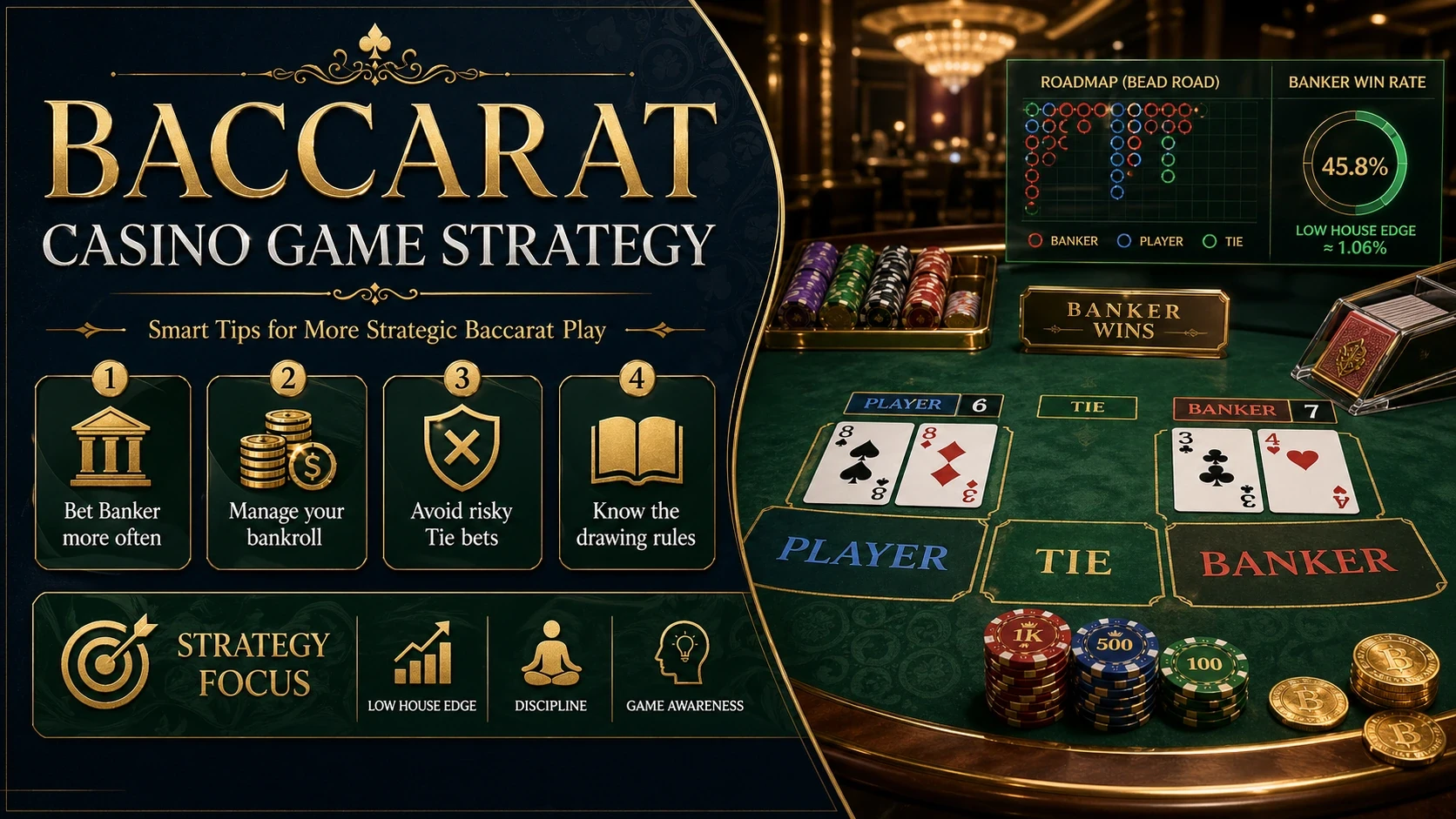
What Is Baccarat Strategy?
Baccarat strategy is different from blackjack strategy. In blackjack, you make decisions such as hit, stand, split, or double down. In baccarat, the drawing rules are automatic, so you do not decide whether the Player or Banker hand takes another card. Your strategy is mainly about choosing which bet to place, how much to stake, when to stop, and which risky bets to avoid.
The main betting options are Banker, Player, and Tie. Some tables also include side bets such as Player Pair, Banker Pair, Perfect Pair, Big, Small, or Dragon Bonus. A strong baccarat strategy starts with understanding that not all these bets have the same risk.
The most practical baccarat strategy for beginners is simple: understand the rules, prefer lower-risk main bets, avoid chasing streaks, manage your bankroll, and be careful with Tie and side bets.
If you are new to the game, first read our full guide to baccarat casino rules. Once you understand card values, Banker and Player hands, natural 8 or 9, and third-card rules, the strategy side becomes much easier to follow.
The Best Baccarat Bet: Why Banker Is Usually Preferred
In most standard baccarat games, the Banker bet is considered the strongest main bet mathematically. This is because the Banker hand acts second under the drawing rules, which gives it a small structural advantage. To balance this advantage, casinos usually charge a commission on winning Banker bets, often around 5%.
Even with commission, Banker is commonly treated as the best default bet because it usually has the lowest house edge among the three main options. This does not mean Banker wins every round. It simply means that over the long term, Banker is generally the most efficient of the main bets.
| Bet | Typical Payout | Strategy View | Beginner Advice |
|---|---|---|---|
| Banker | 1:1 minus commission | Usually the best main bet mathematically. | Good default option for simple strategy. |
| Player | 1:1 | Slightly weaker than Banker, but still a reasonable main bet. | Simple option with no commission in standard baccarat. |
| Tie | Often 8:1 or 9:1 | Higher payout but usually much higher house edge. | Best avoided by strategy-focused beginners. |
A basic baccarat strategy does not need to be complicated. Many players simply bet Banker most of the time and avoid side bets. This does not guarantee profit, but it keeps the strategy aligned with the strongest main bet.
Should You Ever Bet on Player?
The Player bet is also simple and pays even money. It usually has a slightly higher house edge than Banker, but it is still much better than the Tie bet in most baccarat versions. Some beginners prefer Player because there is no commission to calculate.
Betting Player can be part of a casual baccarat strategy, especially if you want to avoid commission tracking. However, if your main goal is to choose the mathematically strongest option, Banker is usually preferred.
Strategy summary: Banker is usually the strongest main bet, Player is still reasonable, and Tie is usually the least attractive of the three main bets.
Why the Tie Bet Is Risky
The Tie bet is attractive because it offers a much larger payout than Banker or Player. However, it wins only when both hands finish with the same total. This happens much less often than a Banker or Player win.
Many beginners see the 8:1 or 9:1 payout and assume the Tie bet is a good way to make a quick profit. In reality, the higher payout exists because the result is harder to hit. From a strategy perspective, the Tie bet is usually not recommended for players trying to reduce risk.
| Feature | Banker / Player | Tie Bet |
|---|---|---|
| Win Frequency | More common | Less common |
| Payout | Usually close to even money | Often 8:1 or 9:1 |
| Risk Level | Lower | Higher |
| Beginner Strategy | More suitable | Usually avoid or treat as entertainment only |
If you decide to place Tie bets, use small stakes and treat them as occasional entertainment rather than a serious strategy.
Baccarat Side Bets: Fun but Usually Riskier
Many online and live dealer baccarat tables include side bets. These may include Player Pair, Banker Pair, Perfect Pair, Either Pair, Dragon Bonus, Big, Small, or other special bets. Side bets can make the game more exciting, but they often carry higher risk than Banker or Player.
The main issue with side bets is that they are usually based on less common outcomes. They may offer attractive payouts, but those outcomes do not occur frequently. This can cause your bankroll to drop faster, especially if you use side bets every round.
| Side Bet | What It Needs | Strategy Advice |
|---|---|---|
| Player Pair | First two Player cards form a pair. | Use sparingly, if at all. |
| Banker Pair | First two Banker cards form a pair. | Check payout and avoid large stakes. |
| Perfect Pair | Pair with same rank and suit. | High payout but rare result. |
| Dragon Bonus | Usually depends on natural win or winning margin. | Rules vary, so read the paytable first. |
A disciplined baccarat strategy usually focuses on Banker and Player while limiting or avoiding side bets.
Flat Betting: The Safest Baccarat Staking Strategy
Flat betting means using the same stake size on each round. For example, if your session stake is €5, you bet €5 on each round rather than increasing or decreasing aggressively after wins or losses.
This is one of the simplest and most responsible baccarat staking methods because it avoids emotional decisions. It also makes it easier to track your bankroll and stop when your session limit is reached.
Flat betting will not guarantee profit. No staking system can do that. However, it can reduce the chance of losing your bankroll too quickly compared with aggressive progression systems.
Progressive Betting Systems: Be Careful
Baccarat players sometimes use progressive betting systems such as Martingale, Fibonacci, Labouchere, or Paroli. These systems change your stake size depending on previous wins or losses. While they may sound attractive, they do not change the underlying odds of the game.
Martingale Strategy
The Martingale system doubles the stake after every loss, aiming to recover previous losses with one win. The problem is that losing streaks can happen, and stake sizes can become very large very quickly. Table limits can also stop the system from continuing.
Positive Progression
Positive progression systems increase stakes after wins instead of losses. They can be less dangerous than Martingale-style systems, but they still do not guarantee profit.
| System | How It Works | Main Risk |
|---|---|---|
| Flat Betting | Same stake every round. | Still subject to normal variance. |
| Martingale | Double after each loss. | Can escalate quickly during losing streaks. |
| Fibonacci | Increase stakes using Fibonacci sequence after losses. | Can still grow beyond your comfort level. |
| Paroli | Increase after wins. | Winning streaks can end suddenly. |
The safest approach for most beginners is to avoid complicated systems and focus on controlled staking, good bet selection, and clear stop limits.
Bankroll Management for Baccarat
Bankroll management is more important than any betting pattern. Baccarat can move quickly, especially in live dealer games. Without clear limits, it is easy to play more rounds than planned.
Set a Session Budget
Decide how much you can afford to lose before you start playing.
Use Small Stakes
Keep individual bets small compared with your total bankroll.
Stop on Time
Set win and loss limits before the session begins.
A practical rule is to divide your bankroll into many small units. For example, if your session bankroll is €100, betting €2 or €5 per round gives you more time and flexibility than betting €20 per round.
Do Baccarat Patterns and Scoreboards Work?
Many baccarat tables show scoreboards with past Banker, Player, and Tie results. These roads and bead plates are part of baccarat culture, especially in land-based and live dealer games. Some players use them to look for streaks or patterns.
However, previous results do not predict the next hand. Baccarat outcomes are random, and each round is independent. A long Banker streak does not mean Banker must lose soon, and several Player wins in a row do not guarantee the pattern will continue.
Scoreboards can be interesting, but they should not replace bankroll control or basic bet selection. Treat them as entertainment, not as a reliable prediction method.
Strategy for Live Dealer Baccarat
Live dealer baccarat uses real cards and a human dealer streamed from a studio or casino floor. The rules are usually the same as standard baccarat, but the pace and table limits may differ.
Before playing live baccarat, check the minimum bet, maximum bet, commission rules, side bets, and game speed. Some tables are designed for casual players, while others are aimed at high rollers.
If you play from your phone, choose reliable mobile casinos where live baccarat loads smoothly, the betting buttons are easy to use, and the table information is visible on smaller screens.
Baccarat Strategy and Casino Bonuses
Casino bonuses can be useful, but baccarat is not always the best game for clearing wagering requirements. Many bonuses give full contribution to slots, while table games such as baccarat may contribute less or be excluded completely.
Before using a bonus at baccarat tables, check the bonus terms carefully. Look for game contribution, maximum bet limits, expiry dates, and whether live dealer games are allowed.
If you are comparing welcome deals, start with the best sign up casino bonus page and check whether baccarat is eligible before claiming any offer. You should also compare online casinos based on game selection, payment speed, bonus transparency, and responsible gambling tools.
Bonus strategy tip: baccarat may be a strong low-complexity table game, but it is often weaker than slots for bonus wagering because many casinos restrict table game contribution.
Baccarat vs Slots: Strategy and RTP
Baccarat and slots are very different casino games. Baccarat is a table game with fixed drawing rules and a small number of main bets. Slots rely on random spins, paylines, features, volatility, and Return to Player percentages.
If you want to understand how slot returns work before switching between baccarat and slots, read our guide on what is RTP in slots. RTP is more relevant to slots than baccarat, but the general idea of understanding game math is useful for all casino players.
| Feature | Baccarat | Slots |
|---|---|---|
| Main Decision | Choose Banker, Player, Tie, or side bets. | Choose game, stake, volatility, and features. |
| Strategy Focus | Bet selection and bankroll management. | RTP, volatility, bankroll, and bonus rules. |
| Round Control | Drawing rules are automatic. | Each spin is independent and instant. |
| Bonus Contribution | Often low or excluded. | Often higher, especially for eligible slots. |
Payment Strategy: Deposits and Withdrawals Matter Too
Good baccarat strategy is not only about how you bet. It also includes choosing a casino with reliable deposits, fair withdrawal rules, and clear verification requirements.
Before depositing, compare available casino payments methods. Check minimum deposits, payout speed, possible fees, supported currencies, and whether your chosen method is eligible for bonuses.
This is especially important for live baccarat players who may use larger stakes or shorter sessions. A smooth cashier experience can make the overall casino experience much better.
Baccarat Strategy vs Sports Betting Strategy
Baccarat strategy is very different from sports betting strategy. In baccarat, the rules are fixed and the main decision is which table bet to place. In sports betting, you analyze odds, teams, players, injuries, market movement, and bet types.
The connection is bankroll discipline. Whether you play baccarat or bet on sports, you need a clear budget, realistic expectations, and a willingness to stop when your limit is reached.
Common Baccarat Strategy Mistakes
1. Betting Tie too often
Tie has a tempting payout, but it is much riskier than Banker or Player. Beginners should avoid making Tie their main strategy.
2. Using Martingale without understanding the risk
Doubling after losses can quickly create large stakes. A short losing streak can damage your bankroll or hit the table limit.
3. Trusting streaks too much
Banker and Player streaks can happen, but they do not predict the next result.
4. Ignoring commission
If you bet Banker, understand how commission works and whether the table is standard or no commission baccarat.
5. Playing side bets every hand
Side bets can be exciting, but they usually increase risk and can drain your bankroll faster.
6. Claiming bonuses without checking baccarat contribution
If baccarat contributes 0% or very little to wagering, it may not help you clear bonus requirements.
Simple Baccarat Strategy Checklist
If you want a simple beginner-friendly baccarat strategy, use this checklist before you play:
| Strategy Step | Why It Matters |
|---|---|
| Learn the basic rules first | You should understand card values, Banker, Player, Tie, and naturals before betting. |
| Prefer Banker as the default main bet | Banker is usually the strongest main bet mathematically. |
| Use Player as a simple alternative | Player is easy to understand and normally pays even money without commission. |
| Avoid Tie as a main strategy | Tie has a high payout but is usually much riskier. |
| Limit side bets | Side bets often carry higher risk than main bets. |
| Use flat betting | Flat stakes help control bankroll swings. |
| Set stop-loss and stop-win limits | Clear limits help prevent emotional decisions. |
Responsible Baccarat Play
No baccarat strategy can guarantee profit. The best strategy is one that helps you understand the game, reduce avoidable mistakes, and stay in control of your budget.
Set a fixed session bankroll before playing. Do not chase losses. Do not increase stakes because you feel a win is “due.” If baccarat stops being fun, take a break.
Baccarat is simple, fast, and entertaining, but it is still gambling. Always play within your limits and only gamble where it is legal and safe to do so.
FAQ: Baccarat Casino Game Strategy
What is the best baccarat strategy?
The simplest baccarat strategy is to understand the rules, prefer the Banker bet, avoid frequent Tie and side bets, use flat betting, and manage your bankroll carefully.
Is Banker always the best bet in baccarat?
Banker is usually considered the strongest main bet mathematically, even with commission. However, it does not win every round and cannot guarantee profit.
Should beginners avoid the Tie bet?
Yes, beginners who want a lower-risk strategy should usually avoid Tie as a regular bet because it has a higher payout but occurs less often.
Does Martingale work in baccarat?
Martingale can appear effective in short sessions, but it does not change the odds. Losing streaks, table limits, and bankroll limits make it risky.
Can baccarat patterns predict the next hand?
No. Scoreboards and streaks can be interesting, but they do not reliably predict future results. Each round should be treated independently.
Is baccarat good for clearing casino bonuses?
Not always. Many casino bonuses give low or zero wagering contribution to baccarat and other table games. Always check bonus terms first.
Final Thoughts: Keep Baccarat Strategy Simple
Baccarat strategy does not need to be complicated. The game has automatic drawing rules, so your main decisions are which bets to place and how to manage your bankroll.
For most beginners, the strongest approach is to learn the rules, prefer Banker, use Player as a simple alternative, avoid Tie and side bets as regular bets, and keep stakes consistent. This will not guarantee wins, but it helps you avoid many of the most common baccarat mistakes.
Treat baccarat as entertainment, set clear limits, and focus on making informed decisions rather than chasing patterns or guaranteed systems.