Rules in Blackjack: Complete Beginner Guide to Blackjack Rules, Card Values and Player Decisions
Blackjack is one of the most popular casino table games because it combines simple rules with real player decisions. The goal is to beat the dealer by getting closer to 21 without going over. This detailed guide explains the rules in blackjack, card values, betting rounds, hit, stand, double down, split, insurance, dealer rules, payouts, common mistakes, and beginner tips for online blackjack.
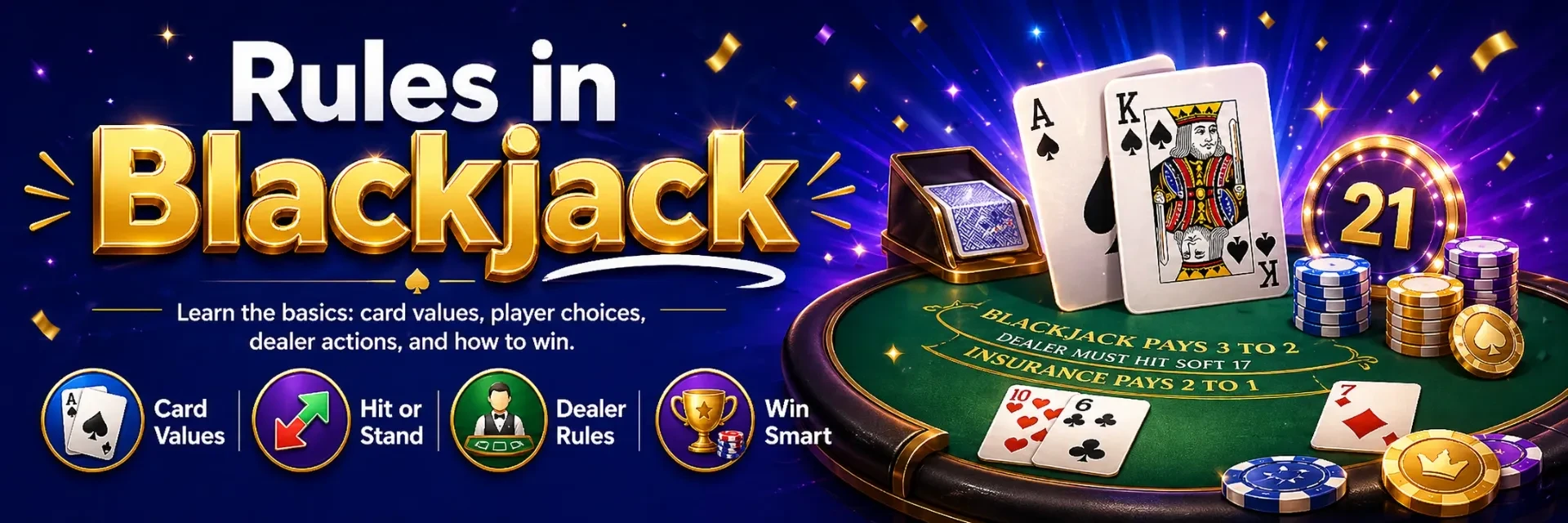
What Is Blackjack?
Blackjack is a casino card game played between the player and the dealer. The main goal is to finish with a hand value closer to 21 than the dealer’s hand, without going over 21. If your hand goes over 21, you bust and lose the bet immediately, even if the dealer later busts as well.
Unlike games such as bingo or keno, blackjack includes meaningful decisions after the cards are dealt. You can choose to hit, stand, double down, split pairs, or sometimes take insurance. These decisions make blackjack more strategic than many simple number-draw games.
In simple terms: blackjack is about making better decisions than random guessing. You cannot control the cards, but you can control how you play each hand.
If you are comparing different casino games at online casinos, blackjack is one of the most important table games to understand because it has clear rules, multiple variants, and a strong connection between strategy and long-term results.
The Main Objective in Blackjack
The objective in blackjack is not simply to reach 21. The real goal is to beat the dealer. You can win with 18 if the dealer has 17, and you can lose with 20 if the dealer has 21. The best possible starting hand is an ace plus a 10-value card, which is called a blackjack or natural blackjack.
A player can win in several ways:
- Your hand is closer to 21 than the dealer’s final hand.
- The dealer busts and your hand has not busted.
- You are dealt a natural blackjack and the dealer does not also have blackjack.
You can lose if your hand busts, if the dealer finishes closer to 21, or if the dealer has blackjack and you do not. If both you and the dealer have the same final total, the result is usually a push, meaning your original bet is returned.
Blackjack Card Values
Blackjack card values are easy to learn. Number cards are worth their face value, picture cards are worth 10, and aces can be worth either 1 or 11 depending on which value helps the hand more.
| Card | Value | Example |
|---|---|---|
| 2 to 10 | Face value | A 7 is worth 7 points. |
| Jack, Queen, King | 10 points | A King is worth 10 points. |
| Ace | 1 or 11 points | Ace + 7 can be 8 or 18. |
A hand containing an ace counted as 11 is called a soft hand. For example, Ace + 6 is soft 17 because the ace can still change from 11 to 1 if another card would otherwise make the hand bust. A hand without an ace, or with an ace that must count as 1, is called a hard hand.
How a Blackjack Round Works
A blackjack round follows a simple structure. First, players place bets. Then the dealer gives cards to each player and to themselves. The player acts first, making decisions based on their hand and the dealer’s visible card. Once all players finish, the dealer completes their hand according to fixed dealer rules.
| Step | What Happens | Player Role |
|---|---|---|
| 1 | Players place their bets. | Choose your stake before cards are dealt. |
| 2 | Each player receives two cards. | Check your hand total. |
| 3 | The dealer receives cards, usually with one card face up. | Use the dealer’s upcard to guide your decision. |
| 4 | Players choose actions such as hit, stand, double or split. | Make decisions according to your hand and table rules. |
| 5 | The dealer plays according to fixed rules. | No player decision remains. |
| 6 | Hands are compared and payouts are made. | Win, lose, push, or receive blackjack payout. |
Hit, Stand, Double Down and Split
The most important blackjack rules involve player actions. Once you receive your first two cards, you decide how to play the hand. These decisions are what make blackjack different from automatic table games such as baccarat.
| Action | Meaning | Example | Beginner Note |
|---|---|---|---|
| Hit | Take another card. | You have 12 and ask for one more card. | Useful when your hand is too low to stand. |
| Stand | Take no more cards. | You have 19 and keep your total. | Used when your hand is strong enough. |
| Double Down | Double your bet and receive one final card. | You have 11 and double against a weaker dealer card. | Powerful move, but only when the situation is favorable. |
| Split | Separate a pair into two hands with an extra bet. | You receive 8-8 and split into two hands. | Some pairs should usually be split; others should not. |
| Surrender | Give up half your bet and end the hand. | You surrender a very weak hand if allowed. | Not available at all tables. |
| Insurance | Side bet offered when dealer shows an ace. | You bet that the dealer has blackjack. | Usually not recommended for most beginners. |
The best action depends on your cards, the dealer’s upcard, the number of decks, and the table rules. Beginners should learn basic strategy rather than guessing each hand.
Dealer Rules in Blackjack
The dealer does not make strategic decisions like the player. Instead, the dealer follows fixed rules set by the table. Most blackjack games require the dealer to hit until reaching at least 17. The key difference is whether the dealer hits or stands on soft 17.
| Dealer Rule | Meaning | Player Impact |
|---|---|---|
| Dealer stands on all 17 | The dealer stops on hard 17 and soft 17. | Generally better for players than dealer hitting soft 17. |
| Dealer hits soft 17 | The dealer takes another card on Ace + 6. | Usually slightly worse for players. |
| Dealer hits 16 or less | The dealer must draw until reaching 17 or higher. | Standard blackjack rule. |
| Dealer checks for blackjack | Dealer may check hidden card when showing ace or 10-value card. | Affects how quickly blackjack is resolved. |
Always read the table rules before playing. Small differences can affect the game’s long-term return and the best strategy decisions.
Blackjack Payout Rules
Standard winning hands usually pay 1:1, also called even money. If you bet €10 and win a normal hand, you receive €10 profit plus your original stake back. A natural blackjack often pays more, but the exact payout depends on the table.
| Result | Typical Payout | Example with €10 Bet |
|---|---|---|
| Normal win | 1:1 | €10 profit |
| Natural blackjack | Often 3:2 or sometimes 6:5 | 3:2 pays €15 profit on €10; 6:5 pays €12 profit. |
| Push | No win, no loss | Your €10 bet is returned. |
| Insurance win | Usually 2:1 | Insurance side bet pays if dealer has blackjack. |
Beginner tip: a blackjack table that pays 3:2 for natural blackjack is generally more attractive than a table that pays 6:5, assuming other rules are similar.
What Is a Blackjack?
A blackjack, also called a natural blackjack, happens when your first two cards are an ace and a 10-value card. The 10-value card can be a 10, Jack, Queen, or King.
A natural blackjack usually beats all non-blackjack hands, even if another hand totals 21 with three or more cards. For example, Ace + King beats 7 + 6 + 8, even though both totals equal 21.
If both the player and dealer have blackjack, the result is usually a push. If the player has blackjack and the dealer does not, the player receives the blackjack payout.
Hard Hands and Soft Hands
Understanding hard and soft hands is essential for blackjack strategy. A hard hand either has no ace or has an ace that must count as 1. A soft hand contains an ace that can still count as 11 without busting the hand.
| Hand Type | Example | Why It Matters |
|---|---|---|
| Hard Hand | 10 + 7 = hard 17 | If you hit and draw a high card, you can bust. |
| Soft Hand | Ace + 6 = soft 17 | The ace can count as 1 or 11, giving more flexibility. |
| Soft Hand Becomes Hard | Ace + 6 + King = hard 17 | The ace changes from 11 to 1 to avoid busting. |
Soft hands are often stronger because they give you more room to draw another card without immediately busting.
Pair Splitting Rules
When your first two cards have the same value, you may be allowed to split them into two separate hands. To split, you place an additional bet equal to your original stake. Each card becomes the first card of a new hand.
Splitting can be powerful when used correctly, but not every pair should be split. For example, splitting 8s is usually common because 16 is a weak hand, while two 8s can become two better hands. Splitting 10-value cards is usually not recommended because 20 is already a very strong total.
| Pair | General Beginner View | Why |
|---|---|---|
| Aces | Often split | Two aces can become two strong starting hands. |
| 8s | Often split | 16 is weak, and splitting gives better potential. |
| 10s | Usually do not split | 20 is already a very strong hand. |
| 5s | Usually do not split | 10 is a strong doubling hand in many situations. |
Rules for splitting can vary. Some tables allow re-splitting, some limit split aces, and some restrict doubling after a split.
Double Down Rules
Double down is one of the most important blackjack moves. It allows you to double your original bet in exchange for receiving exactly one more card. After that card, your hand stands automatically.
Doubling is often used when the player has a strong starting hand and the dealer shows a weaker upcard. For example, many beginners learn that 11 is a strong doubling hand because there are many 10-value cards that can turn it into 21.
Double down can increase profit in favorable situations, but it also increases risk because you are committing more money and receiving only one additional card.
Some blackjack tables allow doubling on any two cards, while others only allow it on specific totals such as 9, 10, or 11. Always check the table rules before betting.
Insurance and Even Money
Insurance is a side bet offered when the dealer’s upcard is an ace. It pays if the dealer has blackjack. While it can seem like protection, insurance is usually not recommended for most beginners because it is a separate bet with its own risk.
Even money is a related option sometimes offered when you have blackjack and the dealer shows an ace. Taking even money guarantees a smaller payout instead of risking a push if the dealer also has blackjack. Whether this is good depends on the rules and mathematical context, but beginners should be cautious with insurance-style decisions.
Basic Strategy in Blackjack
Basic strategy is a mathematically calculated guide that tells you the best action for each hand based on your cards and the dealer’s upcard. It does not guarantee a win, but it reduces avoidable mistakes and helps you play closer to the game’s best theoretical return.
A basic strategy chart usually covers hard totals, soft totals, and pairs. For example, the correct move for hard 16 against a dealer 10 may differ from the correct move for hard 11 against a dealer 6. Guessing these decisions can increase the house edge.
Hard Totals
Hands without a flexible ace, such as 12, 15, or 17.
Soft Totals
Hands with an ace that can count as 11 without busting.
Pairs
Hands where splitting may be possible, such as 8-8 or A-A.
Blackjack is more strategic than baccarat casino rules, where the drawing decisions are automatic. If you enjoy games with simple betting decisions, baccarat may feel easier. If you enjoy making hand-by-hand choices, blackjack may be more engaging.
Blackjack Variants and Rule Differences
Not every blackjack table uses the same rules. Online casinos may offer Classic Blackjack, European Blackjack, Atlantic City Blackjack, Vegas Strip Blackjack, Blackjack Switch, Spanish 21, and live dealer blackjack. Each version can change payouts, dealer rules, deck count, split rules, and doubling rules.
| Rule Difference | What to Check | Why It Matters |
|---|---|---|
| Blackjack payout | 3:2 or 6:5 | 3:2 is generally better for players. |
| Dealer soft 17 | Stand or hit | Dealer standing on soft 17 is generally more player-friendly. |
| Number of decks | Single, double, six, eight, or more | Deck count can affect strategy and house edge. |
| Double down rules | Any two cards or limited totals | Flexible doubling is usually better. |
| Splitting rules | Re-splitting, split aces, double after split | More flexible split rules often help players. |
| Surrender | Available or not available | Surrender can help reduce losses in certain bad spots. |
Blackjack RTP, House Edge and Game Math
Blackjack is often discussed in terms of house edge rather than RTP, but the ideas are connected. RTP means Return to Player and shows the theoretical long-term return of a game. House edge is the opposite side of that calculation.
For example, if a game has a theoretical return of 99.5%, the house edge is 0.5%. Blackjack can have a low house edge when played with good rules and correct strategy, but poor decisions can make the game much more expensive over time.
If you want a deeper explanation of return percentages in casino games, read our guide on what is RTP in slots. Slots and blackjack work differently, but understanding RTP helps explain why game rules and long-term averages matter.
Blackjack and Casino Bonuses
Blackjack may not always be the best game for clearing casino bonuses. Many bonus terms give full wagering contribution to slots but lower contribution to blackjack, baccarat, roulette, and other table games. Some bonuses exclude blackjack completely.
Before claiming a promotion, read the bonus terms carefully. Check game contribution, maximum bet limits, expiry dates, withdrawal conditions, and whether live dealer blackjack counts toward wagering.
If you are looking for new-player offers, compare the best sign up casino bonus options and confirm whether blackjack is eligible before playing with bonus funds.
Bonus tip: blackjack can be a strong strategy game, but many casinos restrict its contribution toward wagering requirements. Always check bonus terms first.
Online Blackjack vs Live Dealer Blackjack
Online blackjack can be played as a digital table game or as live dealer blackjack. Digital blackjack uses software to deal cards instantly, while live dealer blackjack streams a real dealer and real cards from a studio or casino floor.
| Feature | Digital Blackjack | Live Dealer Blackjack |
|---|---|---|
| Game Speed | Usually faster | Usually slower and more realistic |
| Dealer | Software-based | Human dealer via live stream |
| Atmosphere | Simple and private | Closer to land-based casino feel |
| Rules | Varies by game version | Varies by table and provider |
| Best For | Practice and fast sessions | Players who enjoy real table interaction |
If you prefer playing from your phone, choose reliable mobile casinos with smooth blackjack tables, clear buttons, visible rules, and secure account tools.
Blackjack Payments and Withdrawals
Blackjack rules control the game, but payment rules control the casino experience. Before playing for real money, check which deposit and withdrawal methods are available, how long payouts take, and whether verification is required.
You can compare common casino payments methods before choosing a site. Look at minimum deposits, withdrawal limits, transaction fees, supported currencies, and whether your preferred payment method qualifies for bonuses.
This matters because even a good blackjack table can become frustrating if the casino has unclear withdrawal rules or slow payment processing.
Blackjack Compared With Baccarat, Bingo and Keno
Blackjack is often grouped with casino table games, but it plays very differently from baccarat, bingo, and keno. Blackjack gives players more decisions, while bingo and keno are mostly draw-based games.
| Game | Main Mechanic | Player Decisions | Best For |
|---|---|---|---|
| Blackjack | Beat the dealer without going over 21. | Hit, stand, double, split, surrender. | Players who enjoy strategy decisions. |
| Baccarat | Bet on Banker, Player, or Tie. | Mainly bet selection. | Players who prefer automatic drawing rules. |
| Bingo | Match numbers on cards to complete patterns. | Choose tickets and game rooms. | Players who like social number games. |
| Keno | Pick numbers and match the draw. | Choose spots and stake. | Players who like quick lottery-style games. |
For more table-game context, read our guide to baccarat casino game strategy. If you prefer number games, the guides on what bingo means and how keno works explain simpler draw-based games.
Blackjack vs Sports Betting
Blackjack and sports betting require very different thinking. In blackjack, you respond to cards and fixed table rules. In sports betting, you analyze odds, teams, markets, injuries, form, and real-world events.
The connection is bankroll management. Whether you play blackjack or bet on sports, you should set limits, avoid chasing losses, and understand the risk before placing a wager.
Common Beginner Mistakes in Blackjack
Blackjack is easy to learn, but beginners often make mistakes that increase the house edge. Here are some of the most common ones:
1. Playing without learning basic strategy
Guessing every decision can lead to poor choices. A basic strategy chart helps you make more consistent decisions.
2. Taking insurance too often
Insurance may look protective, but it is usually not a strong bet for most casual players.
3. Splitting 10-value cards
A total of 20 is already very strong. Splitting 10s usually turns one strong hand into two uncertain hands.
4. Standing too often on weak totals
Some players stand because they are afraid to bust, but standing on weak totals can allow the dealer to win easily.
5. Ignoring table rules
Blackjack payout, dealer soft 17 rule, surrender, splitting and doubling rules can all affect the game.
6. Playing with bonus funds without checking contribution
Blackjack may contribute little or nothing toward wagering requirements. Always check bonus rules first.
Beginner Blackjack Rules Checklist
Before you play blackjack online, use this quick checklist:
| Rule to Check | Why It Matters |
|---|---|
| Blackjack payout | 3:2 is usually better than 6:5. |
| Dealer soft 17 rule | Dealer standing on soft 17 is generally more player-friendly. |
| Double down rules | More flexible doubling can improve your options. |
| Split rules | Re-splitting and doubling after split can matter. |
| Surrender availability | Surrender can reduce losses in certain bad hands. |
| Table limits | Choose stakes that match your bankroll. |
| Bonus contribution | Some bonuses restrict blackjack wagering contribution. |
Responsible Blackjack Play
Blackjack is a strategic game, but it is still gambling. Correct decisions can reduce the house edge, but they cannot guarantee profit. Even strong players can lose in the short term because cards are random and variance is part of the game.
Set a budget before playing, use table limits that fit your bankroll, avoid chasing losses, and stop when the session stops being enjoyable. If you use a bonus, check the rules carefully and make sure the requirements are realistic.
The best blackjack experience comes from understanding the rules, playing with discipline, and treating the game as entertainment rather than income.
FAQ: Rules in Blackjack
What are the basic rules in blackjack?
The basic rules are simple: try to beat the dealer by getting closer to 21 without going over. You can hit, stand, double down, split pairs, and sometimes surrender depending on the table rules.
What is the value of an ace in blackjack?
An ace can be worth 1 or 11, depending on which value helps the hand more. This creates soft hands, such as Ace + 6, which can count as 7 or 17.
What does hit mean in blackjack?
Hit means taking another card. Players hit when they want to improve their hand total, but hitting can also cause the hand to bust if it goes over 21.
What does stand mean in blackjack?
Stand means you take no more cards and keep your current hand total. The dealer then plays after all players have completed their decisions.
What is a blackjack hand?
A blackjack is a two-card hand made of an ace and a 10-value card. It usually pays more than a normal win if the dealer does not also have blackjack.
Is blackjack a game of skill or luck?
Blackjack includes both luck and skill. The cards are random, but player decisions such as hit, stand, double and split can affect long-term results.
Can I play blackjack on mobile?
Yes. Many online casinos offer mobile blackjack and live dealer blackjack games that work on smartphones and tablets.
Final Thoughts: Blackjack Rules Are Easy to Learn but Important to Master
The rules in blackjack are simple enough for beginners to understand quickly: beat the dealer, get close to 21, and avoid busting. However, the game becomes much more interesting when you learn how card values, dealer rules, doubling, splitting, payouts, and basic strategy work together.
Before playing online blackjack, check the table rules, choose a sensible stake, learn basic strategy, and understand how bonus terms may affect blackjack play. A good blackjack player is not someone who wins every hand, but someone who makes informed decisions and manages risk carefully.
Play responsibly, use blackjack as entertainment, and always choose trusted casino platforms with clear rules, secure payments, and fair gameplay.